
Dog Cargo Flight Cost Calculator
Select Your Route
Estimated Costs
Select route and weight to see estimate
Important Notes: Prices exclude vet fees, crate purchase, and customs paperwork. Extreme temperatures may affect travel eligibility.
If you’ve ever tried to book a flight with a dog that weighs more than 20 pounds, you already know the truth: most airlines won’t let big dogs sit with you in the cabin. It’s not personal. It’s not about your dog being "bad"-it’s about space, safety, and regulations. Airlines have strict rules because a 90-pound Labrador doesn’t fit under a seat, and no one wants a dog bouncing around during turbulence. So what do you do when your loyal companion is too big for the cabin? You don’t have to cancel your trip. You just need to know your options.
Why Airlines Restrict Big Dogs in the Cabin
Airlines set weight and size limits for cabin pets based on real-world physics. The standard rule? Your dog, plus the carrier, must fit under the seat in front of you. That’s usually a maximum of 20 pounds (9 kg) total. Even if your dog is calm and well-behaved, if it’s over that limit, it’s not allowed. This isn’t just about comfort-it’s about emergency evacuation. In a crisis, every passenger must be able to exit quickly. A large dog in the aisle or under a seat slows that down. Airlines like Delta, United, American, and Southwest all follow this rule. Even if you pay extra, they won’t bend it. There’s no loophole. No "but my dog is sweet" exception.
What Counts as a "Big Dog"?
It’s not just about weight. A 25-pound Beagle might fit under a seat. A 22-pound Great Dane? Probably not. Size matters more than scale. Airlines measure the carrier’s dimensions, not just the dog’s weight. Most carriers must be no larger than 19 x 13 x 9 inches (48 x 33 x 23 cm). That’s roughly the size of a medium-sized backpack. If your dog can’t sit, stand, or turn around inside that space without touching the sides, it’s too big. Breeds like Golden Retrievers, German Shepherds, Bulldogs, and Rottweilers almost always exceed this. Even some Labradors and Boxers do. If your dog’s height at the shoulder is over 18 inches (46 cm), it’s very likely you’ll need to book cargo.
How to Fly Your Big Dog in Cargo
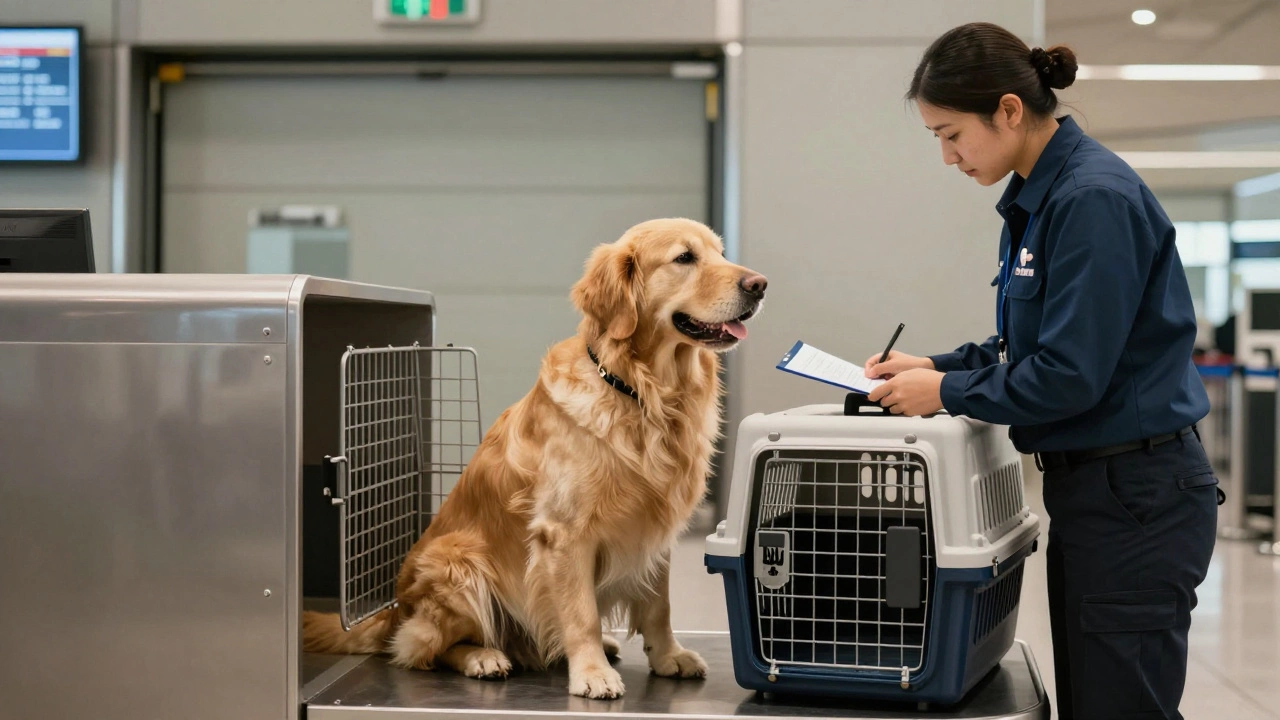
Flying your dog in cargo isn’t scary if you prepare right. The cargo hold is pressurized, climate-controlled, and monitored. It’s not a storage closet-it’s a regulated space designed for live animals. Most major airlines use the same system: your dog travels in a hard-sided, IATA-approved crate. This isn’t a soft carrier. It’s a plastic or fiberglass crate with ventilation on all sides, a secure latch, and your dog’s name and your contact info clearly marked. You’ll need to drop your dog off at the airport’s special pet check-in counter, usually 2-3 hours before departure. The crate gets loaded last and unloaded first. Your dog will be checked on every few hours during long flights. Airlines like KLM, Lufthansa, and Delta have dedicated animal handlers on staff.
What You Need Before Booking Cargo
- Approved crate: Must meet IATA Live Animals Regulations. Look for the IATA logo on the crate.
- Health certificate: Issued by a vet within 10 days of travel. Some countries require it within 7 days.
- Vaccination records: Especially rabies. Some destinations (like the EU) require a microchip and EU Pet Passport.
- Acclimation: If you’re flying in extreme heat or cold, airlines may refuse travel. Check temperature restrictions before booking.
- Weight limit: Most airlines cap crate weight at 100 lbs (45 kg) including the dog and crate. Some allow up to 150 lbs (68 kg) for extra fees.
Don’t wait until the last minute. Cargo slots fill up fast, especially during holidays. Book as soon as you book your flight.

Costs: How Much Does It Really Cost?
Flying your dog in cargo costs more than cabin travel-but not as much as you think. Cabin pet fees are usually $125 one-way. Cargo fees? They range from $250 to $700 one-way, depending on distance and weight. For example:
| Route | Weight Range | Fee (One-Way) |
|---|---|---|
| US Domestic (e.g., NYC to LA) | 50-70 lbs (23-32 kg) | $300-$400 |
| US to EU (e.g., Chicago to Dublin) | 60-80 lbs (27-36 kg) | $500-$650 |
| US to Australia | 70-90 lbs (32-41 kg) | $700-$900 |
These prices don’t include vet fees, crate purchase, or quarantine (if required). For international trips, add $150-$300 for customs paperwork and health checks. Budget accordingly.
What You Should Never Do
Some people try to sneak big dogs into the cabin by pretending they’re service animals. Don’t. Fake service animals are illegal in the US, EU, Canada, and Australia. Airlines now require documentation for legitimate service dogs, including a signed vet form and proof of training. If you’re caught lying, you’ll be fined, banned from flying with pets, and your dog could be quarantined. It’s not worth it. Another bad idea? Buying a soft carrier and hoping they don’t check. Airlines weigh and measure every pet carrier at check-in. They have scales. They have rulers. They’ve seen it all.
Alternatives to Flying
If flying feels too stressful-or too expensive-consider ground travel. Many pet transport companies specialize in long-distance dog transport. Companies like PetRelocation, Dogtainers, and even some local vets offer door-to-door service with climate-controlled vans. It’s slower, but your dog gets to travel with a handler, not a crate on a conveyor belt. You can even arrange for a stopover to let your dog stretch and rest. For trips under 1,000 miles (1,600 km), this is often cheaper and less stressful than flying. Some owners even drive themselves. A 12-hour road trip with breaks every 2 hours is totally doable with a big dog.
Preparing Your Dog for Cargo Travel
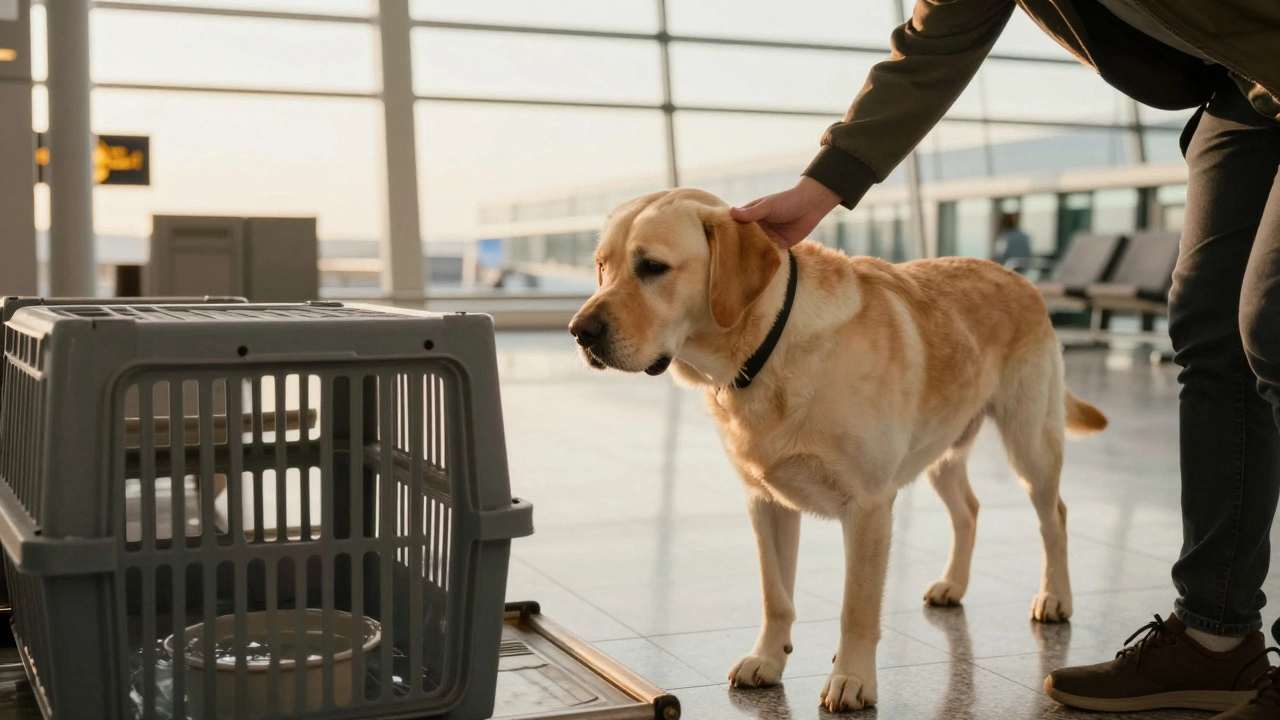
Don’t just throw your dog in a crate and hope for the best. Train them. Start 4-6 weeks before the trip. Let your dog sleep in the crate overnight. Feed meals inside it. Take short car rides with the crate in the back. Make it a safe, familiar space. If your dog panics in crates, talk to your vet about mild sedatives. Most airlines don’t allow heavy sedation, but light calming aids like melatonin (under vet supervision) are often okay. Never give your dog tranquilizers without approval. Some breeds-like Bulldogs, Pugs, and Shih Tzus-have breathing issues. Flying in cargo can be dangerous for them. Talk to your vet before booking.
What Happens During the Flight?
Your dog won’t be alone. Cargo holds are monitored by trained staff. The temperature stays between 60-70°F (15-21°C). The hold is quiet, dark, and pressurized-just like the cabin. Your dog will be loaded last and unloaded first. Most airlines have a 24-hour pet tracking system. You’ll get a tracking number so you can check your dog’s status online. If there’s a delay, your dog stays in a climate-controlled holding area until the flight departs. No one leaves a pet in a hot van or unattended cargo area. That’s not allowed.
Arrival: What to Expect
When you land, go straight to the cargo claim area-not baggage. Your dog will be waiting in a secure, clean room with water and ventilation. The handler will hand you the crate. Check for damage. If the crate is dented or the latch is broken, report it immediately. Your dog might be tired, thirsty, or a little confused. Let them rest. Offer water. Don’t force food right away. Most dogs recover within a few hours.
Can I bring my big dog in the cabin if I pay extra?
No. Airlines don’t allow exceptions based on payment. If your dog exceeds the size or weight limit for cabin pets (usually 20 lbs total), you cannot bring it into the cabin-even if you pay $500. The rule is based on safety and space, not money.
Is flying in cargo dangerous for dogs?
For healthy dogs, cargo travel is safe. Modern airlines use climate-controlled, pressurized holds with trained handlers. Incidents are rare-less than 0.01% of pets flying in cargo experience problems. The biggest risks come from extreme weather, unapproved crates, or pre-existing health conditions. Always get a vet clearance before flying.
What if my dog is over 100 lbs? Can they still fly?
Yes, but only on certain airlines and routes. United, Delta, and Alaska Airlines allow dogs up to 150 lbs (68 kg) in cargo with an extra fee. You’ll need an oversized crate, and some international destinations may not accept pets over 80 lbs. Always check the airline’s pet policy page before booking.
Do I need a microchip for my dog to fly?
For international travel, yes. The EU, UK, Australia, and many other countries require a microchip for pet entry. Even for domestic flights, a microchip is a smart idea. If your crate gets misrouted, it’s the fastest way to reunite you with your dog.
Can I fly with two big dogs together in one crate?
No. Airlines require each dog to have its own crate. Even if they’re siblings or usually sleep together, they must travel separately. This is for safety, hygiene, and to prevent injury during turbulence or handling.