
Dog Noise Nuisance Risk Calculator
Scenario Settings
Risk Assessment Result
Adjust the settings and click "Assess Legal Risk" to see if your situation might violate local noise ordinances.
Generally Acceptable
Most municipalities tolerate short bursts of barking during the day. This is unlikely to be considered a nuisance.
Recommended Action
- • Continue monitoring behavior.
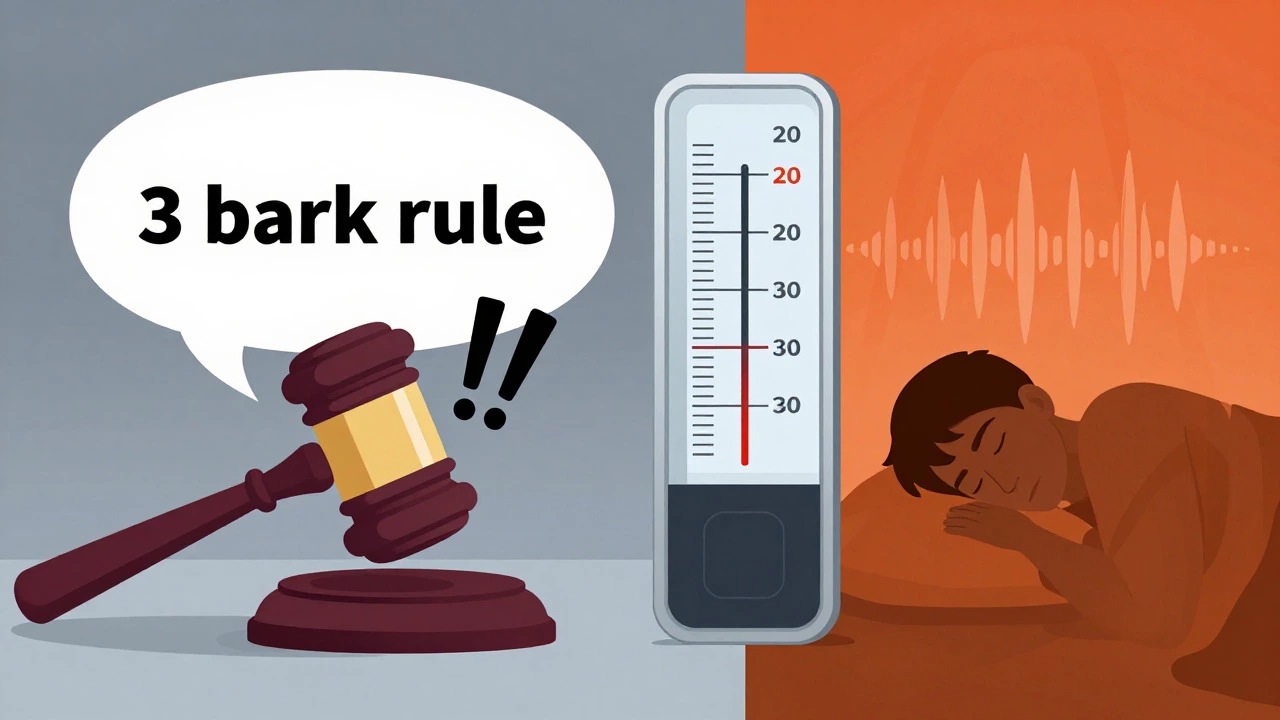
You hear it. That sharp, repetitive sound that cuts through your morning coffee or ruins your evening relaxation. Your dog is barking. The neighbors are looking over the fence with less-than-friendly expressions. You’ve heard whispers about a "3 bark rule"-some mysterious legal limit where if your dog hits three barks in a row, you’re suddenly breaking the law. It sounds specific. It sounds like a hard line you can draw in the sand. But here’s the truth: there is no universal "3 bark rule" written into any national or state constitution.
So why does everyone talk about it? And more importantly, how do you keep your dog quiet enough to avoid trouble without turning your home into a silent prison?
The Myth of the "3 Bark Rule"
The idea of a strict numerical limit on barking is largely an urban legend. While some local ordinances might use vague language like "excessive noise," very few laws specify an exact count. If a city code says a dog cannot bark "more than three times consecutively," it is extremely rare and usually poorly enforced because it is nearly impossible to prove in court without constant video evidence.
Most municipalities rely on Noise Ordinances are local laws that regulate sound levels and disturbances within residential areas. These laws focus on the impact of the noise rather than the count. A single long, piercing yowl at 3 AM is often treated as a violation, while ten short barks during a lively afternoon game might be ignored. The key factor isn’t the number; it’s the duration, the time of day, and whether it unreasonably disturbs the peace.
| Misconception | Legal Reality |
|---|---|
| There is a federal "3 bark rule." | No such federal law exists. Regulations are strictly local. |
| Three barks equals an automatic fine. | Fines usually require proof of "nuisance" or repeated complaints. |
| Dogs have unlimited barking rights at home. | Homeowners must prevent unreasonable disturbance to neighbors. |
| Only loud dogs get cited. | Persistent low-level whining can also trigger violations. |
How Local Laws Actually Work
To understand what gets you in trouble, you need to look at your specific city or county codes. In many places, a dog is considered a Nuisance Animal when it creates a health hazard or persistent disturbance to others. This definition is broad. It covers barking, but also digging up yards, aggressive behavior, or failing to pick up waste.
Typically, enforcement follows a ladder approach:
- Verbal Warning: A neighbor talks to you first. This is the most common resolution.
- Written Complaint: If talking fails, the neighbor calls animal control or non-emergency police. They log the incident.
- Official Notice: You receive a letter citing a violation of the municipal code.
- Fines or Hearings: Repeated offenses lead to monetary penalties. In extreme cases, cities can mandate training or even impoundment.
For example, in some California cities, a dog barking for more than 10 minutes continuously between certain hours can be deemed a nuisance. In New York City, the focus is often on whether the noise violates the "quiet enjoyment" of neighboring apartments. The variation is huge. Checking your local government website for "animal control ordinances" is the only way to know your exact risk.
Why Dogs Bark (And Why Counting Doesn't Help)
Before you reach for a gadget, you need to understand the trigger. Barking is communication. It’s not malicious; it’s functional. If you treat the symptom (the sound) without addressing the cause (the message), the problem will return.
- Territorial Alert: Someone walked by the window. The dog is saying, "I see something. I am guarding this space."
- Boredom/Loneliness: Left alone for hours with no toys or stimulation. The dog is saying, "Something should be happening right now."
- Anxiety: Separation anxiety causes frantic, high-pitched vocalization. The dog is saying, "Where did you go? I’m scared."
- Play/Greeting: You came home! The excitement is overwhelming. The dog is saying, "Hello! Hello! Hello!"
A dog barking out of boredom will not stop just because you hit a counter of three. It needs engagement. A dog barking out of fear needs safety, not silence.
The Role of Dog Collars in Managing Noise
This is where Dog Collars become essential accessories for identification, control, and sometimes training. However, not all collars are created equal when it comes to stopping barking. Many people confuse standard flat collars with specialized training tools.
Standard nylon or leather collars do nothing to stop barking. They are for ID tags and leash attachment. When people mention "barking collars," they are usually referring to one of three types:
- Vibration Collars: Emit a gentle buzz when the microphone detects barking. This startles the dog into silence without pain. It is generally considered the least intrusive electronic option.
- Spray Collars: Release a burst of citronella or scent when the dog barks. Most dogs dislike the smell and associate the barking with the unpleasant surprise. Studies suggest these are effective for territorial barking.
- Static Shock Collars: Deliver a mild electric correction. These are controversial. While they work quickly, animal behaviorists often warn they can increase anxiety if used incorrectly, potentially making the barking worse in the long run.
If you choose to use a training collar, fit is critical. It should sit high on the neck, just behind the ears, where the dog feels the sensation clearly. Too low, and it’s ineffective. Too tight, and it’s dangerous. Always consult a professional trainer before introducing electronic aids.
Training Techniques That Beat Technology
Gadgets are band-aids. Training is the cure. The goal is to teach your dog that silence is rewarding. Here is a simple, proven method called "Quiet Training":
- Trigger the Bark: Have a friend knock on the door or ring the bell. Let your dog bark two or three times naturally.
- Mark the Silence: Wait for a pause. Even a half-second break counts. Say "Quiet" in a calm, firm voice.
- Reward Immediately: The moment the dog stops, give a high-value treat. Praise them softly.
- Repeat and Extend: Do this daily. Gradually increase the time they must stay quiet before getting the treat. Start with 2 seconds, then 5, then 10.
Consistency is your best weapon. If you yell at your dog to shut up, you are often adding to the noise and reinforcing the excited state. Calm leadership works better than angry shouting.

Preventing Complaints Before They Start
Even if you aren’t technically breaking a "3 bark rule," keeping good relations with neighbors prevents escalation. Simple steps include:
- Visual Barriers: Use frosted window film or plant shrubs so dogs can’t see every passerby.
- Exercise First: A tired dog is a quiet dog. A 20-minute brisk walk before you leave for work drains excess energy.
- White Noise: Leave a radio or fan on when you’re gone to mask outside triggers.
- Introduce Yourself: Talk to new neighbors. Explain you’re working on training. People are less likely to call the cops on someone they know and like.
When to Seek Professional Help
If your dog barks constantly despite training, exercise, and environmental changes, you may be dealing with severe separation anxiety or compulsive disorder. This isn’t a behavioral issue you can fix with a collar. It requires a certified veterinary behaviorist. Signs include destruction of property, house soiling, and self-injury alongside the vocalization. Early intervention saves money and stress later.
Is there really a law against 3 barks?
No, there is no widespread law that specifically bans exactly three barks. Most laws prohibit "excessive" or "continuous" barking that disturbs the peace. The "3 bark rule" is mostly a myth or a misinterpretation of local noise ordinances.
What happens if my neighbor calls the police for barking?
Usually, an officer or animal control officer will visit to verify the noise. If the barking has stopped, they may issue a warning. If it continues, they might write a citation. Repeated visits can lead to fines or mandatory training classes depending on your city's code.
Are shock collars illegal?
It depends on your location. Some cities and states, like San Francisco and Utah, have banned or restricted the sale and use of electronic shock collars. Check your local regulations before buying one. Vibration and spray collars are more widely accepted.
How long can a dog bark before it’s considered excessive?
There is no universal time limit. However, many ordinances consider continuous barking for more than 10-15 minutes as excessive. Short bursts throughout the day are usually tolerated unless they occur during quiet hours (often 10 PM to 7 AM).
Can I record my neighbor’s dog barking as evidence?
Yes, audio recordings can help establish a pattern of nuisance. However, laws regarding eavesdropping vary by state. Generally, recording sound from your own property is legal, but check local privacy laws. Video evidence showing the source is often stronger than audio alone.